QR code advertising works when the person looking at the ad can stop, take out a phone and scan. That describes a magazine reader, a newspaper reader and a commuter waiting at a shelter. It does not describe a driver on a highway. This guide covers where a code earns its place, how big it needs to be on each format, and how to tell which ad did the work.
Where does QR advertising work, and where does it not?
The test is simple: can the viewer stop? If they can, a code turns a passive ad into an action. If they cannot, the code is decoration.
- Works: magazine and newspaper ads, bus shelters, station panels, street-level posters, shop windows, leaflets and inserts, event programs.
- Works with care: large outdoor boards beside pavements and plazas, where people slow down but stand some distance away.
- Does not work: boards seen from a moving car, and anything a viewer passes in under a few seconds. Use a short URL or a brand name people can search instead.
A useful habit is to walk the route the audience takes. Stand where the ad will hang, count the seconds a person actually spends there, and note whether their hands are free. A queue, a platform and a waiting room pass. A crossing, a motorway slip road and a fast escalator fail. That ten-minute site visit settles most arguments about whether a code belongs on the artwork.
Many agency briefs get this wrong in one direction or the other. A code on a roadside board wastes the space. Leaving a code off a shelter poster wastes the one place where people stand for two or three minutes with nothing to do.
How do you put a QR code in a magazine or newspaper ad?
Print ads are read close up, so the code can be small. The risks come from the paper and the layout, not the distance.
Newspaper. Newsprint is rough and absorbent, and ink spreads slightly into it. That softens fine detail. Keep the code larger than you would on glossy stock, keep the dark parts clearly dark on a light background, and ask the printer for a proof on the real paper before you approve the run. Do not put a code over a photograph or a tint that varies.
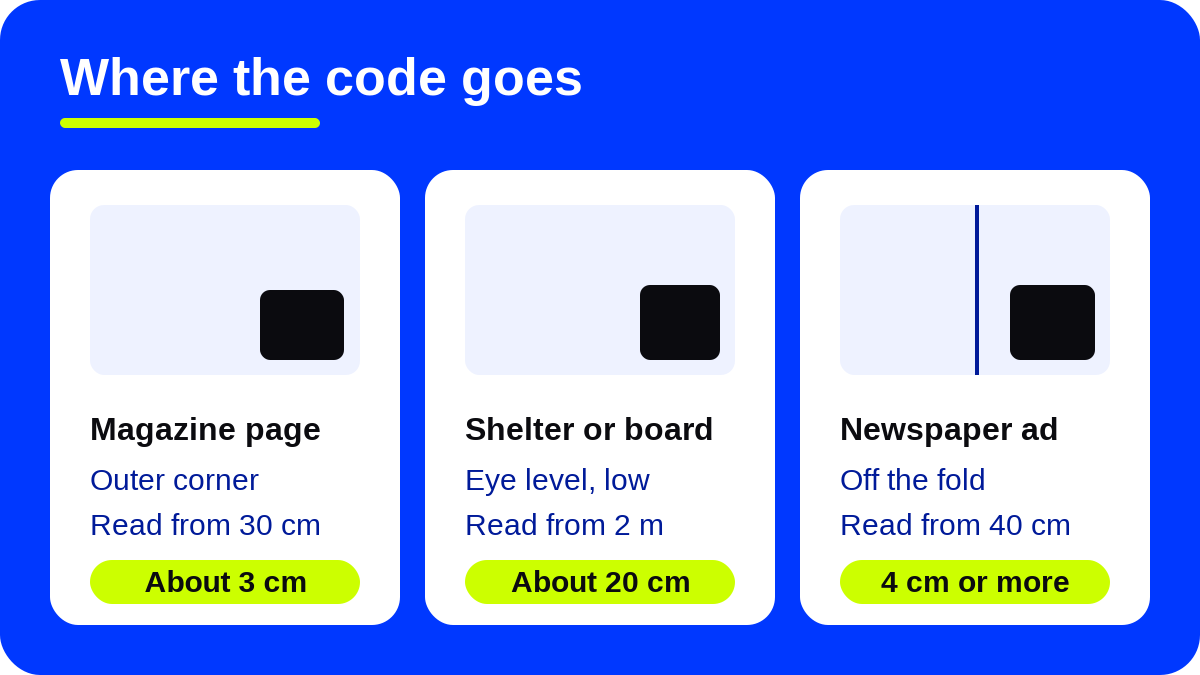
Magazine. Coated paper is kinder, but a spread has a fold. Keep the code out of the gutter, where the page curves away from the lens, and away from the trimmed edge. A lower outer corner is the usual spot. Gloss varnish can bounce light into the camera, so test under the lights of an office, not only under a desk lamp.
Both. Leave a clear border around the code, with no text or artwork touching it. For the full pre-flight, use the QR code print checklist.
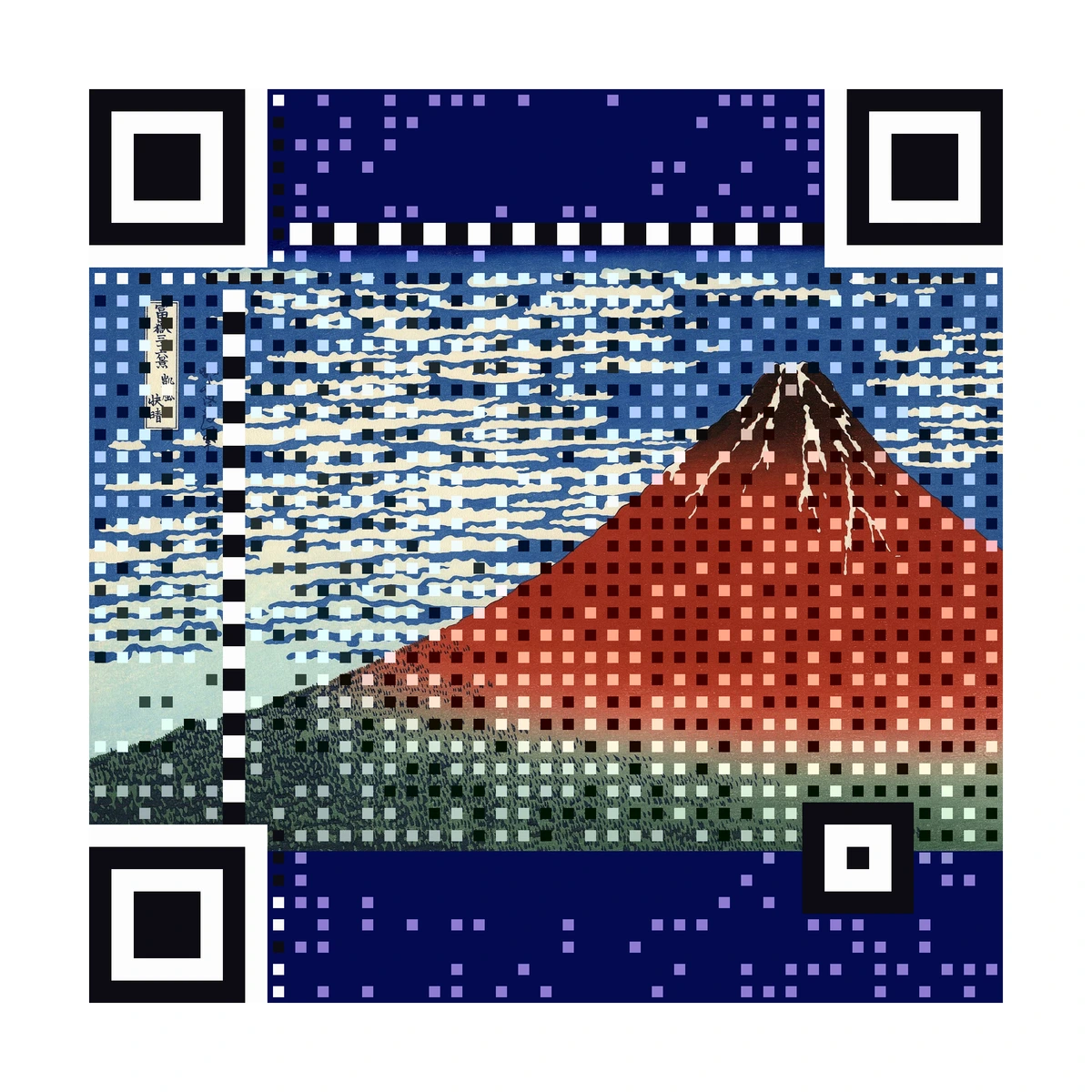
If the ad is made from a photograph, a picture QR code lets the artwork itself carry the code, so the ad does not need a black square stuck in one corner.
How big should the code be on a billboard, shelter or poster?
Use one rule and stay on the safe side of it: make the code about one tenth of the distance it will be scanned from. Roughly 20 cm for a shelter read from 2 m, about 1 m for a wall read from 10 m. This is general guidance, not a guarantee, so go larger when the layout allows.
QR codes on billboards and print ads goes through dwell time, site types and how to compare locations in detail. For a QR code poster at a smaller scale, such as a window or a noticeboard, the same rule applies: stand where the reader will stand and measure from there.
What should the text next to the code say?
Say what the scan gives the reader, in a few words, next to the code. "Scan to see the full range" beats "Scan me". Make the offer specific: a viewing time, a menu, a sample, a booking.
Two sentences are enough to get the basics right here. Put the line directly beside the code, at a size that can be read from the same distance as the code. For tested wording by goal, see QR code call to action.
Format by format: sizes, distance and destination
These are rules of thumb. Your proof on the real material has the final word.
| Format | Where the reader is | Minimum practical size | What to link to |
|---|---|---|---|
| Newspaper ad | Seated, about 40 cm away | About 4 cm, larger on newsprint | One mobile page for the offer in the ad |
| Magazine ad | Seated, arm's length | About 3 cm | A page matching the ad's picture and promise |
| Leaflet or insert | In the hand | About 3 cm | Booking, menu or sign-up |
| Bus shelter or station panel | Standing, 1 to 2 m | About 10 to 20 cm | A short action: book, buy, save |
| Street poster | Standing, 2 to 3 m | About 20 to 30 cm | The same, on a page that loads fast |
| Wall or large outdoor board | Pavement or plaza, 10 m | About 1 m | Only where people can stop |
Whatever the format, send people to a page built for a phone. Mobile landing pages for QR code scans covers what that page needs, and the QR code landing page examples show how others do it.
How do you tell which ad worked?
If the same code appears in three magazines, a newspaper and fifty shelters, you will know the campaign got scans and nothing else. Make one code per placement instead, each sending people to the same destination. In AriaQR these are placements: several codes for one campaign, compared side by side in the dashboard. Placements ride on a subscription plan, so see pricing for what is included.
This is what lets an agency answer the client's real question: which magazine was worth the money, and which shelter was dead. Placements and campaign tracking explains the setup, and QR code tracking for client campaigns shows how to report the results. For the bigger picture, the pillar on QR codes for marketing agencies ties it together.
Real example: a code made from Hokusai's Red Fuji, the picture doing the work that a plain black square would not.
Why a dynamic code matters for a long print run
A magazine ad is printed once and stays in circulation for weeks. A poster runs for a month. A promotion ends, a page moves, someone finds a typo in the link. With a static code, the printed copies are stuck with the mistake. With a dynamic code, you change the destination and every copy already in the world follows it. For the trade-offs, see dynamic vs static QR codes.
Turn on the first-scan alert and the daily link-health check as well. You hear when the first copy is scanned, and you hear if the destination ever breaks while the ad is still running.
Where to start
Pick the one format in your next plan where the viewer can stop. Make one code per placement, size it with the one-tenth rule, and put a specific line beside it. Order a proof on the real paper, scan it with two phones, then approve the run. You can make the code on the QR code generator.