Will the code on a cereal box in 2027 be the same one the cashier scans? Quite possibly, and that is the biggest shift in the future of QR codes: they are moving from a marketing extra on the side of the pack to the main product code that checkouts, regulators and shoppers all read.
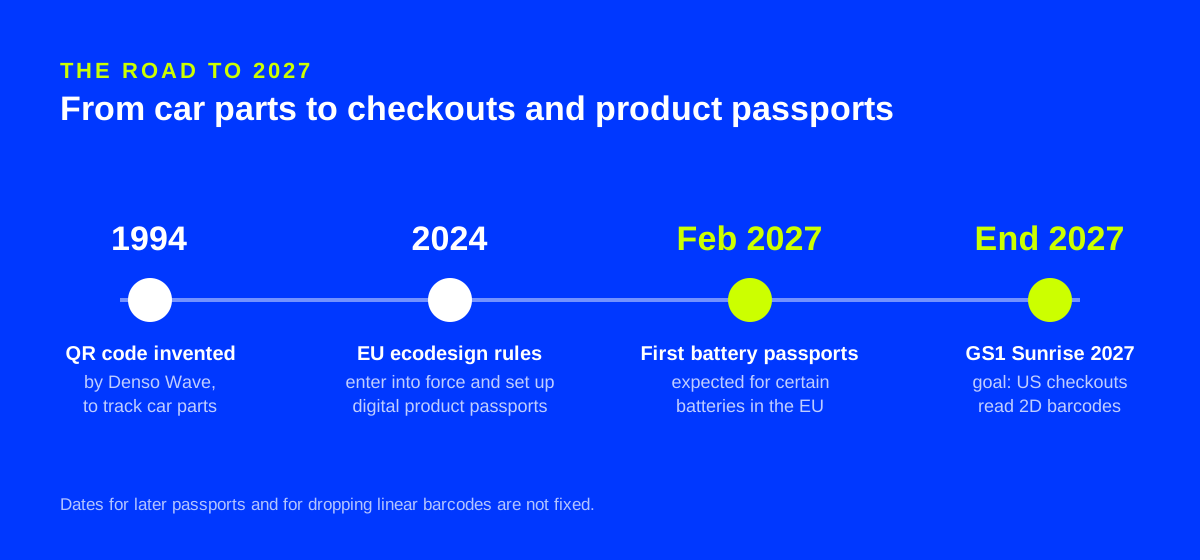
The QR code was invented in 1994 by Denso Wave to track car parts. Three decades later, it is heading back to where it started, as a serious industrial code, while also becoming more visual and more personal than ever. Here is what is actually changing by 2027, and what is still uncertain.
1. Checkouts learn to read QR codes
For about fifty years, retail checkouts have read one-dimensional barcodes: UPC in North America, EAN in most other places. That is starting to change.
GS1 Sunrise 2027 is an industry goal led by GS1 US. The aim is that retail checkout scanners in the US can read 2D barcodes by the end of 2027. The formats in focus are QR codes carrying a GS1 Digital Link and GS1 DataMatrix.
Three things to understand about it:
- It is a readiness target, not a deadline. It is about scanners being able to read 2D codes, not about removing UPC barcodes.
- It is voluntary. It is an industry initiative, not a law, although individual retailers can set their own rules for suppliers.
- One code can do two jobs. A GS1 Digital Link QR code holds the product number for the checkout and a web address for the shopper's phone.
We cover what this means for the barcode itself in will QR codes replace barcodes.
2. Digital product passports arrive in the EU
The European Union is building a digital product passport: a record of a product's materials, origin, repair and recycling information, reached through a data carrier on the product.
The framework comes from the Ecodesign for Sustainable Products Regulation, which entered into force in 2024. The first passport with a firm date is the battery passport: under the EU Battery Regulation, certain batteries, including electric vehicle and larger industrial batteries, are expected to need one from February 2027. Other product groups, such as textiles and steel, are planned to follow, but their timelines depend on rules that are still being adopted.
The regulation talks about a data carrier rather than naming one symbol, so the final technical details matter. A QR code is the carrier most widely discussed, and many brands plan to use GS1 Digital Link so the same code identifies the product and opens its passport. Our glossary entry on the digital product passport has the details.
3. Codes start to look like the brand
When a code is only a small square in the corner of a pack, nobody cares how it looks. When it becomes the main code on the front of the pack, the poster or the shop window, design starts to matter.
That is why design-led codes are growing. Instead of a black grid with a logo pasted in the middle, the picture itself becomes the code: a product photo, a logo, a painting. AriaQR builds codes this way, and each one is verified on real decoders under real-world conditions before download. The artistic QR code generator shows what that looks like in practice.

The example above is a product code built on the GS1 Digital Link standard, made as artwork. During the changeover it sits next to the UPC rather than replacing it.
4. Codes become dynamic by default
A printed code that points to a fixed web address is fragile. Pages move, offers end and manuals change. Expect more codes to carry a short link that can be updated after printing, with scan analytics behind it.
For products, this goes further. A GS1 Digital Link resolver can send the same scan to different places, such as product information, a recall notice or instructions. Packaging stops being a frozen snapshot and becomes something a brand can keep up to date.
5. Safety becomes part of the design
As codes spread, so do fake ones. Quishing, or phishing through a QR code, has been a headline security issue in 2026, from fake parking meter stickers to codes in phishing emails. Our post on QR code phishing in 2026 covers the detail.
The response is already visible:
- Phones preview the address before opening it, and more people are learning to read it.
- Brands use their own domains or short links that can be checked.
- Codes that can be stopped. A dynamic code can be shut down or put behind a warning if its destination turns malicious.
- Branded codes help trust. A code that clearly belongs to the brand on the poster is harder to fake with a generic sticker.
What is still uncertain
Honest forecasts include the unknowns.
- How fast retailers move. Scanner upgrades vary by retailer and country. Some will rely on 2D codes early, others late.
- When UPC can go. No fixed date exists for dropping linear barcodes. Expect both on packs for years.
- Passport details. Rules for most product groups are still being written.
- Phone habits. Most phones scan QR codes from the camera today. How shoppers use those scans in stores is still developing.
Where to start
If you sell physical products, find out whether your GTINs and packaging files are ready for a 2D code, and talk to your retailers before changing anything on pack. If you use codes for marketing, make them dynamic, make them look like your brand and keep the destination on a domain people can check.