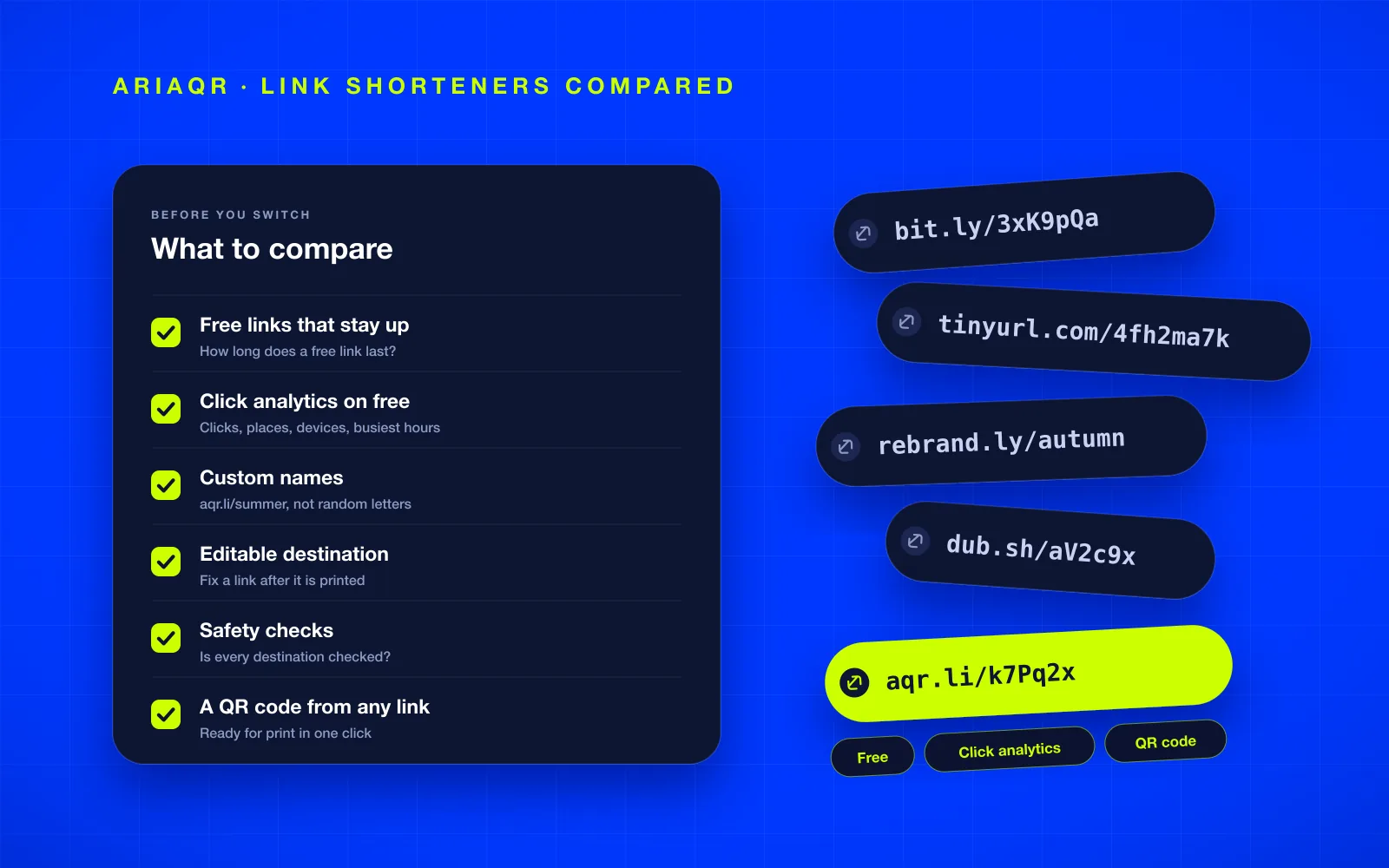
Bitly is the name most people know, and for teams that already run on it, it is a solid choice. But plenty of people searching for Bitly alternatives want something narrower: a free link with real click analytics, a link on their own domain, an open-source tool they can host, or a short link that turns into a print-ready QR code. Each of the services below wins at one of those. This is a fair comparison of what each one is built for, with no invented numbers.
Why do people look for Bitly alternatives?
The reasons tend to fall into a handful of groups:
- The free plan is small. Bitly's free plan is a monthly allowance meant for trying the product, and much of the analytics history sits on paid plans. That is a reasonable business model, and it does not fit someone who wants ten tracked links and no subscription.
- Branded domains. Teams want links on their own domain, such as go.yourbrand.com, so the link looks like it came from them.
- Control. Developers and privacy-minded teams want an open-source tool they can run themselves.
- Print. People who put links on packaging, posters, and menus want the short link and the QR code in one place.
- Simplicity. Someone who needs one short link for one message does not want an account at all.
No single service is best at all five. The table below shows where each one fits.
How do the main Bitly alternatives compare?
Plans and limits change, so this compares what each service is built for rather than the fine print. Check each one's current pricing before you commit.
| Service | Built for | Where it wins | Trade-off to know |
|---|---|---|---|
| Bitly | Link management for teams | Mature platform, QR codes, link-in-bio pages, integrations | Free plan is a small trial allowance; check their current pricing |
| TinyURL | Quick links, no fuss | You can shorten a link without an account; custom aliases | Analytics and branded domains sit behind an account and paid plans |
| Rebrandly | Branded links | Built around links on your own domain | The value is in the domain features; check their current plans |
| Short.io | Branded links and an API | Custom domains and developer tooling | Set-up starts with a domain you own |
| Dub | Modern link platform | Open-source code, API, custom domains, conversion tracking | Aimed at product and marketing teams; check their current plans |
| YOURLS | Self-hosted shortener | Free, open source, fully yours | You run the server, the domain, updates, and abuse handling |
| AriaQR (aqr.li) | Tracked links that also go on paper | Free click analytics on up to 10 links, cookie-free counting, a QR code or art code from any link, safety checks on every link | No links on your own domain; free links keep their destination; sign-in required |
Bitly: still the default for a reason
Bitly is a full link-management platform: short links, QR codes, link-in-bio pages, campaign tools, team features, and integrations with the marketing tools many companies already use. If your team manages hundreds of links across channels and wants one dashboard and one vendor, it is hard to beat on breadth.
Where it fits less well is the small end. Its free plan is designed for trying the product, not for running a handful of tracked links indefinitely. If that describes you, one of the services below will feel lighter. For a direct look at Bitly's QR side against ours, see Bitly QR code generator vs AriaQR.
TinyURL: the quickest one-off link
TinyURL has been around longer than most of the web services you use. Its strength is speed: paste a link, get a short one, optionally with a custom alias, and you do not need an account to do it. For a link in one email or one message, that is often all you need.
The trade-off is the flip side of that convenience. Analytics, branded domains, and link management sit behind an account and paid plans, so check their current pricing if tracking matters. And anonymous shortening, on any service, is the kind of openness scammers like, which is worth knowing when you are on the clicking end. Our guide to whether short links are safe covers how to check one before you tap.
Rebrandly and Short.io: your own domain
If the reason you are leaving Bitly is branding, these two are the usual shortlist. Both are built around links on a domain you own, with the domain set-up, link management, and APIs to go with it. A link like go.yourbrand.com/spring reads as yours, which helps trust and recall.
The trade-off is set-up. You need a domain, DNS changes, and someone to own the account. For a brand team with a web person, that is an afternoon. For a solo creator, it may be more than the job needs.
Dub and YOURLS: open source
Developers often land on these. Dub is a modern link platform whose code is published as open source; it offers a hosted service with custom domains, an API, and conversion tracking, and you can run it yourself. YOURLS is a long-running, free, open-source shortener that you install on your own server and domain.
Self-hosting gives you full control of the data and no vendor limits. It also hands you the hosting, the updates, the backups, and the abuse handling. A public shortener on your domain that gets used for phishing can land your domain on blocklists, so plan for that before you open it up.
AriaQR (aqr.li): free tracked links that also go on paper
The aqr.li shortener is built for people who want real numbers on a few links and who often need those links in print as well.
- Free, with analytics. Up to 10 short links per account, each with clicks over time, unique visitors, countries and cities, devices, browsers, in-app browsers such as Instagram and WhatsApp, the busiest hours in the visitor's local time, and a CSV export. Visitors are counted without cookies.
- Honest terms. A free link lives for a year and renews free with one click from the reminder email. No ads on the way to your page.
- Safety on every link. Every destination is checked against Google Safe Browsing when the link is made and re-checked over time. Links to other shorteners and to IP addresses are refused, anyone can report a link, and a blocked link never redirects.
- A QR code from any link. One click makes a free classic QR code, or an art code where your image becomes the code, verified on real decoders under real-world conditions before download.
- More with a plan. Paid plans and Business add far more links, no end date and a destination you can change at any time. Custom names such as aqr.li/summer are free on every account. See pricing.
Where AriaQR is not the right pick: if you need links on your own domain, choose Rebrandly, Short.io, Dub, or Bitly. If you want a link without signing in, TinyURL is faster. If you manage thousands of links across a large marketing team, Bitly's breadth may matter more. The full walk-through of the free plan is in free URL shortener with analytics.
How do you choose a Bitly alternative?
Answer four questions and the list gets short fast:
- Do you need your own domain? Yes: Rebrandly, Short.io, Dub, or Bitly. No: keep reading.
- Do you need analytics on the free plan? Yes: check what each free plan actually shows. aqr.li includes the full dashboard.
- Will the link go on paper? Yes: pick a service that makes a tracked QR code for the same destination, so print gets measured too.
- Do you want to run it yourself? Yes: YOURLS or a self-hosted Dub.
Then test it the boring way. Make a link, share it in one place, and look at the dashboard the next day. If the numbers answer your question, you have found your shortener.
Where to start
If your answers were "no own domain, yes analytics, maybe print", open the URL shortener, sign in with an email code, and shorten the link you are sharing next. When it needs to go on a poster or a pack, make the QR code from the shortener in one click. For more free, in-browser utilities around links and codes, browse the AriaQR tools.