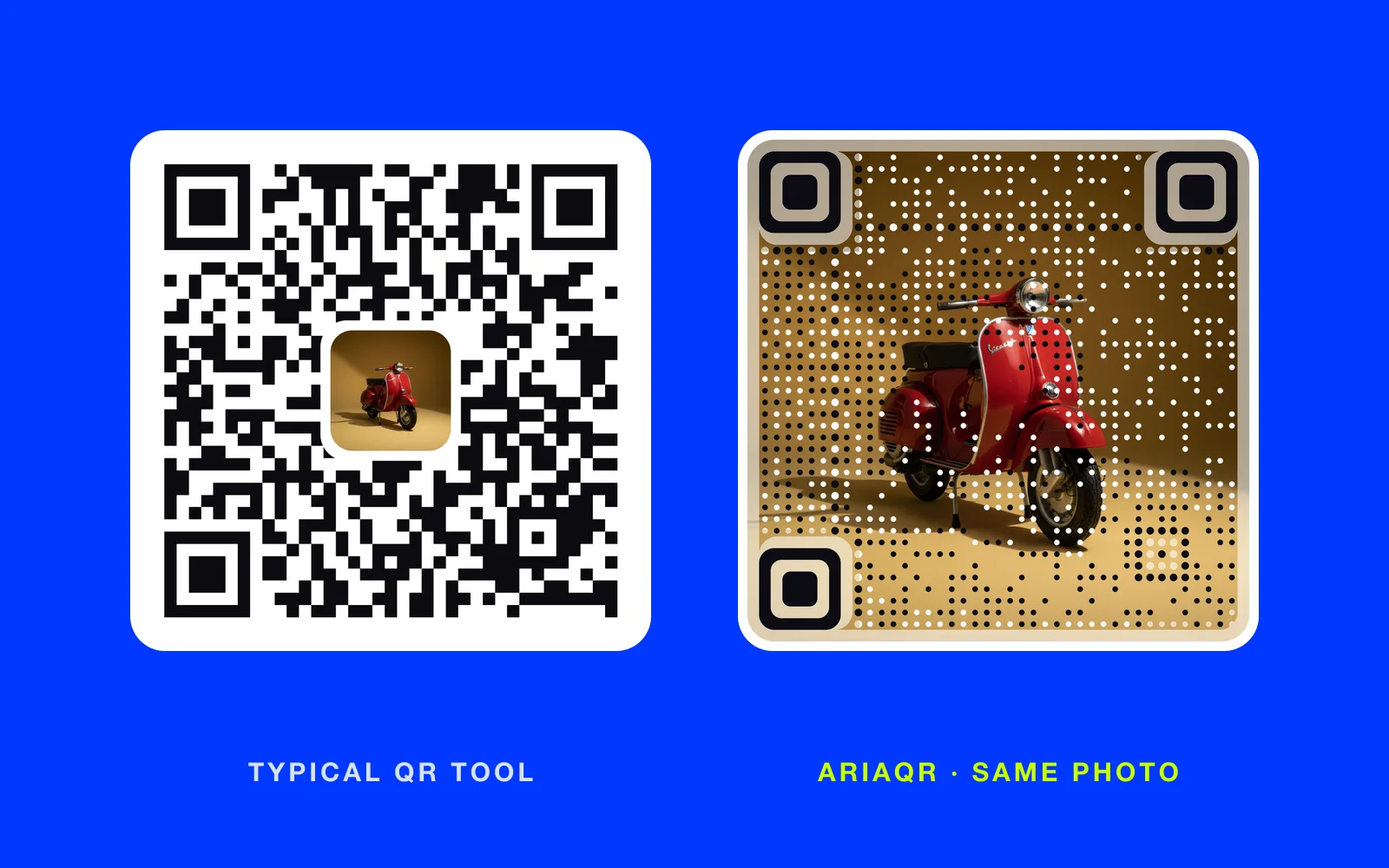
Uniqode, formerly Beaconstac, is an enterprise QR platform built for teams that manage many codes: bulk generation, analytics, user roles, and integrations. AriaQR is a different kind of tool: it makes a code out of your image, verifies that it scans on real decoders before download, and tracks it without a team plan. If you run QR codes at organizational scale, Uniqode is the stronger choice; if you need a single code that is the artwork and is proven to scan, AriaQR is.
What is Uniqode (formerly Beaconstac)?
Uniqode is the current name of the company many people still search for as Beaconstac. In general terms it is a QR code platform aimed at businesses and enterprises: dynamic codes you can edit after printing, scan analytics, bulk creation for large runs, landing pages, and team features with roles and permissions. It offers API and integration options for connecting codes to other systems, and it is often mentioned alongside the "phygital" idea of linking physical products and places to digital experiences.
The codes are styled grids. You can pick colors, patterns, eye shapes, and a frame, and you can put a logo in the center. The output is consistent and on-brand across large batches, which is the point when you are labeling thousands of items.
If you searched "uniqode careers" or "uniqode funding", this is not that post; we are only comparing the product. And if you landed here from "unicode to non unicode", that is a text-encoding question and unrelated.
What does AriaQR do differently?
AriaQR makes the image the code. Upload a logo, a photo, an illustration, or a product shot, and the code lives inside it as a field of dots. Finder eyes and margins are translucent so the picture shows through. With "Code in your image", the code is placed inside a larger poster or photograph and you get the whole artwork back with the code blended in. The visual difference from a styled grid is shown in regular QR vs AriaQR.
Every code is verified on real decoders under real-world conditions before download: distance, angle, low light, small size. The site shows a verdict only, "verified" or "scans up close only", and you pick the build: Standard for screens and prints of 4 cm and up, or Small print, verified down to about 1.5 cm for cards, labels, and stickers. The reasoning behind that step is in how we verify every code.
Codes are dynamic by default. Each encodes an AriaQR short link, so you can change the destination after printing and every scan is tracked. Wi-Fi and payment codes are static kinds that work offline in any scanner. Styles can be changed after generation without disturbing the link or the analytics. Accounts are optional. What AriaQR does not do today: team seats, bulk generation, white label, or integrations beyond webhooks and CSV export.
AriaQR vs Uniqode: side by side
| AriaQR | Uniqode (formerly Beaconstac) | |
|---|---|---|
| What the code looks like | The image itself is the code; dots live inside your picture, eyes and margins translucent | Styled grid with colors, patterns, frames, and a logo in the center |
| Verification before download | Yes, on real decoders under real-world conditions, verdict shown first | Not advertised |
| Dynamic and editable links | Default for most kinds; static for Wi-Fi and payment | Yes, dynamic codes |
| Analytics depth | Scans, unique visitors, hour-of-day heatmap, device and OS, in-app browser, city and postal code, map | Scan analytics in their platform |
| Placements and campaigns | Yes, several codes per campaign compared side by side | Campaign grouping in their platform |
| Team features | Not today | Yes, users, roles, and permissions |
| Bulk generation | No | Yes |
| Integrations | Webhooks and CSV export | API and integrations |
| Pricing model | Pay once per code, or subscribe (see pricing) | Check their current pricing |
Which is better for enterprise use?
Uniqode, and it is not close. If you need to generate a thousand codes from a spreadsheet, hand different departments their own folders, restrict who can edit destinations, or push scan events into a CRM through an API, that is what an enterprise platform is for. AriaQR does not have team features, bulk generation, or those integrations today, and we would rather say so than pretend.
Where AriaQR fits inside a larger organization is the hero placement: the one code on the packaging front, the trade show wall, the campaign poster, where the code is part of the design and has to scan under bad lighting from an awkward angle. Make that one on AriaQR, check the verdict, and download the 2048px master. For packaging specifically, branded QR codes for packaging covers sizes and finishes. Scan data still flows out through webhooks and CSV export, so it can sit next to everything else.
How does the analytics compare?
Both platforms count scans on dynamic codes. On AriaQR, every dynamic code includes total scans, unique visitors measured without cookies, scans per day, an hour-of-day heatmap in the scanner's local time, device and OS split, in-app browser detection, and country, region, city, and postal code when the network allows, plus a real map with clustering. Location is IP-based with no permission prompts. Placements let you compare several codes in one campaign side by side, and alerts by email or webhook cover the first scan, a broken destination, and a digest. Daily link-health checks catch dead destinations. See placements and campaign tracking for how teams use them.
Uniqode's reporting is designed for many users across many codes, with the roles and exports an organization expects. If your reports need to be sliced by department, that is its strength.
What about Uniqode pricing vs AriaQR?
We do not state competitor prices or plan names. Check Uniqode's current pricing and note what is charged per user and per code.
AriaQR offers two options: pay once for a single code, or subscribe if you make codes regularly. Verification, dynamic links, and analytics are included in both. See pricing.
Where to start
If you are evaluating platforms for a whole company, put Uniqode on the shortlist for scale, roles, and integrations. If you have one piece of artwork that needs to become a code you can trust on press day, make it on AriaQR without an account, check the verdict, and download.
Who should pick which
Pick Uniqode if you manage QR codes as an operation: many users, many codes, bulk runs, permissions, and API connections into your systems. Beaconstac built that over years, and AriaQR does not offer those features today.
Pick AriaQR if the code is the artwork and it has to be verified, editable, and tracked without a team plan. Brand designers, agencies, packaging teams, event planners, real estate, and hospitality are the usual fit. Pay once per code or subscribe; see pricing.