What Is a QR Code? How QR Codes Actually Work, Explained
What is a QR code, and how does a QR code actually work? We take one apart: who invented it, how a phone reads it in a split second, and why a damaged code still scans.
A QR code is a two-dimensional barcode, read across and down. It was invented in 1994 at Denso Wave to track car parts, and QR stands for Quick Response. In this episode of the QR Code Encyclopedia you'll see the finder patterns, timing lines, alignment square and quiet zone; the 40 versions, from 21×21 up to 177×177 modules; how your text becomes bytes laid out in a zigzag; what the format strip and the 8 mask patterns do; error correction levels L, M, Q and H; and the six steps your camera runs when you scan.
You scan them every day, on menus, parcels, tickets, and posters.
But what actually is a QR code?
A barcode is read in one direction.
A QR code is read across and down, so one small square holds far more.
It was invented in 1994 at Denso Wave to track car parts on the factory floor.
QR stands for quick response.
Every cell is a module.
Three finder squares tell the camera where the code is and which way up.
Timing lines count the grid.
An alignment square fixes the angle.
And the quiet zone keeps it clear.
There are 40 sizes.
Version 1 is 21 modules wide.
Version 40 is 177 and holds up to 7,089 digits.
So where does the message actually go?
Everything else in the square is data.
Your text is turned into bytes.
Each byte fills eight modules, laid in a zigzag, two columns at a time, starting from the bottom right corner.
Next to the finders sits the format strip.
It tells the scanner the error correction level and which mask was used.
A mask flips modules in a set pattern so the code never forms big blocks or shapes that could confuse a camera.
There are eight.
The encoder picks the cleanest.
Then comes the clever part: error correction.
Extra code words let the code rebuild whatever is missing.
Level L recovers about 7%, M, 15, Q, 25, and H, 30.
Scratch it, smudge it, tear off a piece.
Within limits it still scans.
And here is what your camera does in a split second.
It finds the three finders, straightens the grid, reads the format, removes the mask, fixes the errors, and opens your message.
Links, contacts, Wi-Fi, payments, tickets, all in one square.
For years, you needed a separate app to read one.
Then in 2017, phone cameras started reading them on their own.
And by 2020, they were on restaurant tables everywhere.
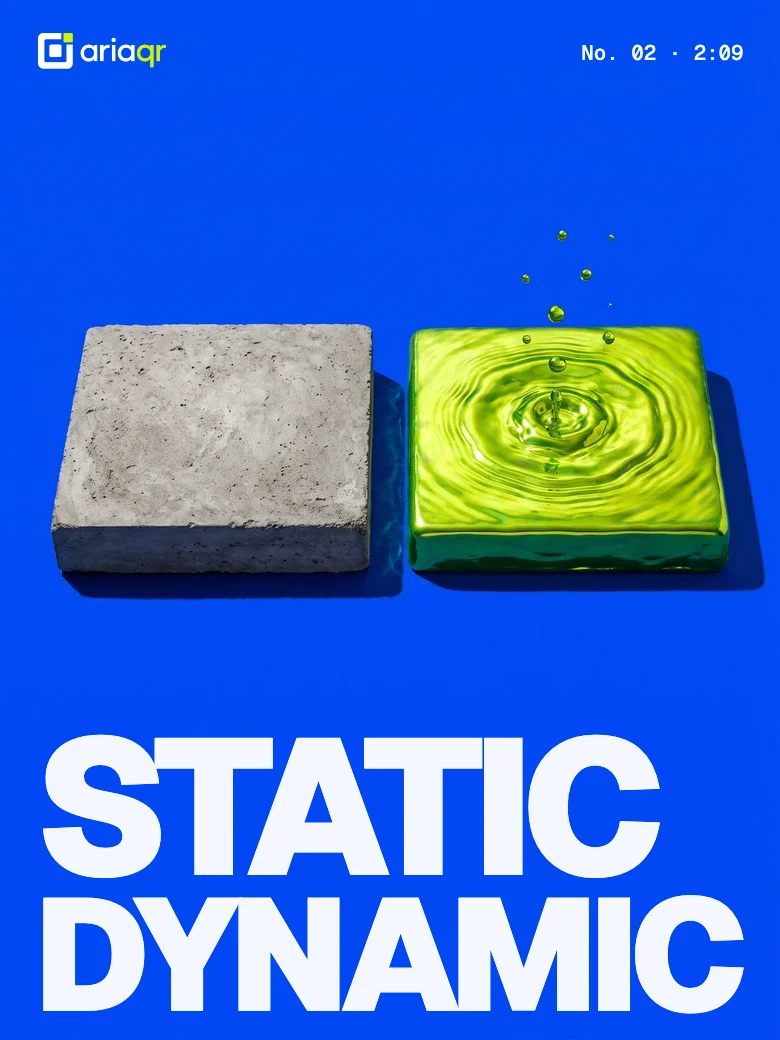
Some codes are static.
The message is written right into the pattern, and it can never change.
Others are dynamic.
They hold a short link so you can change where it goes later and count every scan.
And nothing says it has to look like this.
AriaQR turns any image into a QR code that still looks like your image, tested on real scanners before you pay.
Make yours at ariaqr.com.
A QR code doesn't have to be a black square.